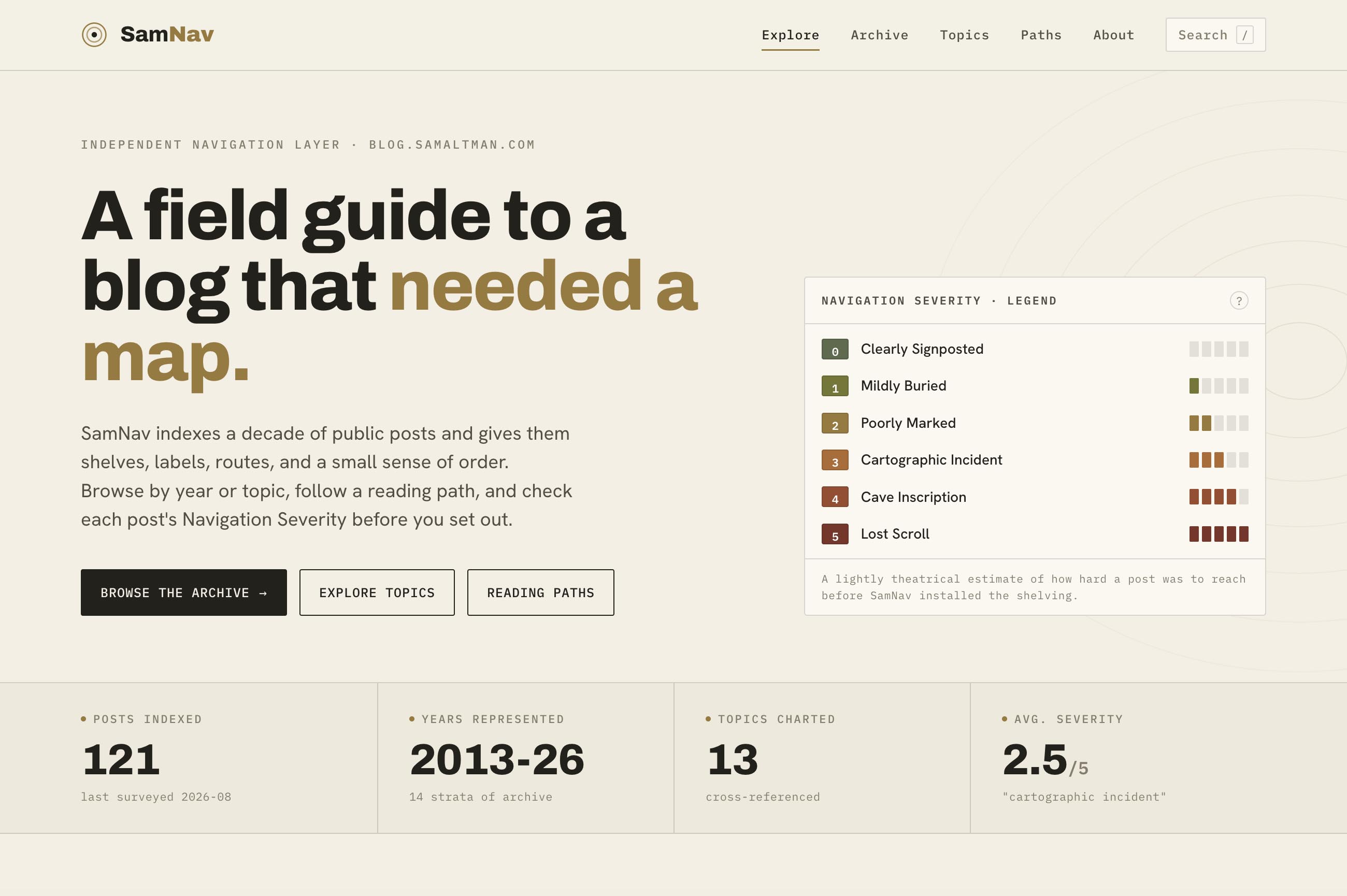
Sam Altman’s public blog contains more than a decade of consequential writing and almost no meaningful way to move through it. SamNav began as the missing map: an independent index with search, controlled topics, related posts, chronology, and curated reading paths.
The project deliberately stores directions rather than articles. Full text is used only inside the private indexing pipeline; the public site receives safe metadata and always returns the reader to the original source. The design principle is simple: less extraction, more orientation.
The original atlasA searchable, cross-referenced field guide that stores directions to the writing and sends every reader back to the source.
Install the shelving
3 publishing stages
121
public posts indexed
14
publication years
13
controlled topics
8
curated reading paths
01
Discover the record
The public Atom feed and archive month buckets reveal candidate posts before a polite crawler fetches each original page.
Atom and archive discovery
Polite source requests
Content-hash change detection
Failure-safe refreshes
02
Build the catalog
A local enrichment pipeline turns raw source material into structured, public-safe records without publishing article bodies.
Controlled topics
Summaries and reading time
Related and adjacent posts
Navigation Severity
03
Publish the map
Astro and Pagefind produce a fast static atlas while scheduled workflows keep the public catalog current.
Static archive and topic pages
Pagefind search
Curated reading paths
Links to original sources
Catalog boundary
Public source
Private crawl
Local enrichment
Public metadata
Static atlas
Original post
A finished product has logic
The next feature had to deepen the map.
SamNav was already live, coherent, and quietly doing its peculiar job when OpenAI Build Week arrived. Adding a generic AI chat window would have made the application larger and the idea smaller.
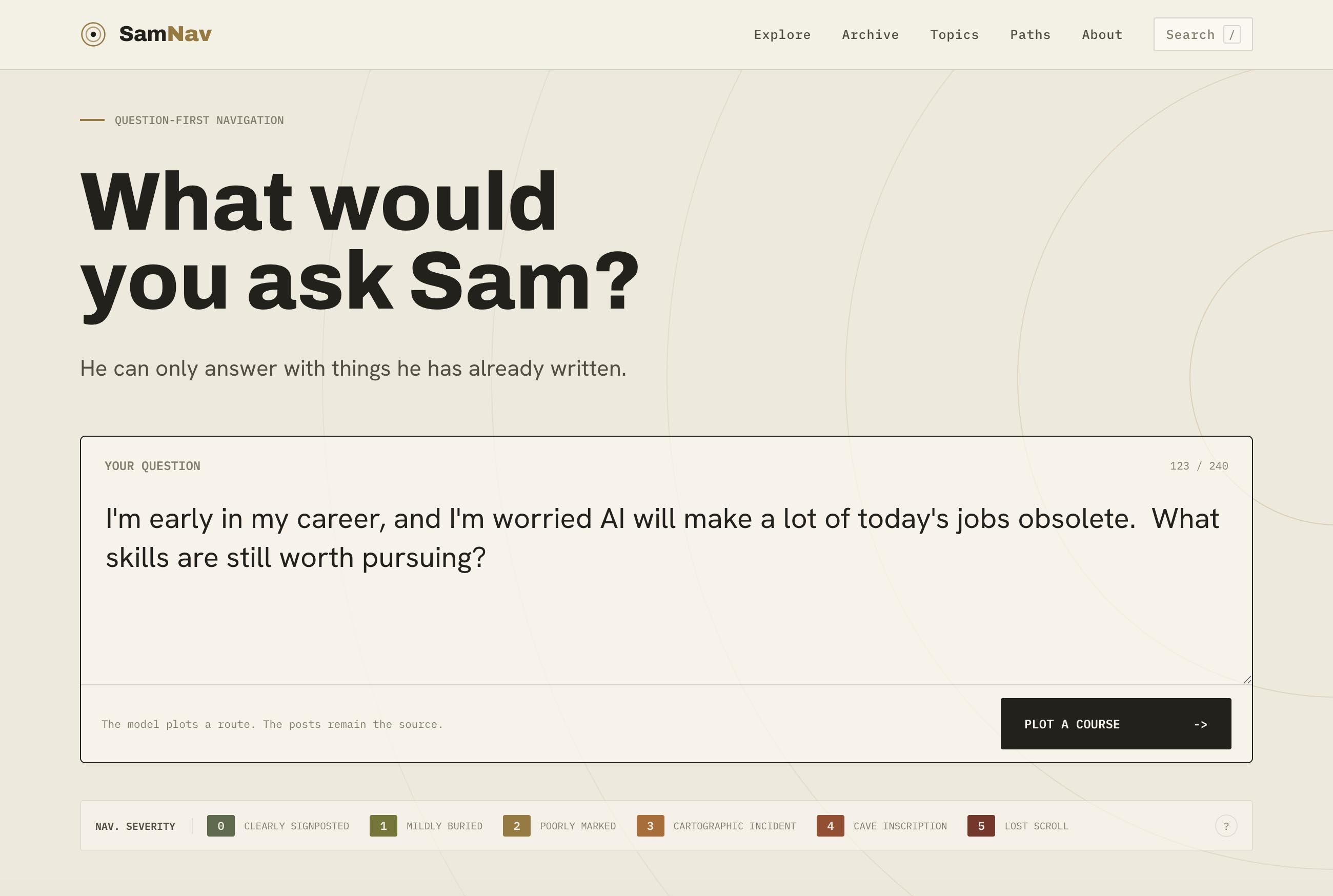
The useful extension arrived as a question: What would you ask Sam? The constraint became the product. He can answer only through things he has already written; the answer is an arrangement of source material, not a simulated personality.
Question-first navigationThe interface asks for an intention, not a keyword. The model plots a route; the posts remain the source.
How Ask Sam works
3 bounded stages
121
semantic dossiers
14
records in the bounded shortlist
23
deterministic tests
11
retrieval benchmarks
01
Interpret intent
A bounded reader question is normalized, screened, and embedded without entering ordinary logs, analytics, or replay.
Bounded input
Moderation
Turnstile verification
Private operational telemetry
02
Retrieve narrowly
Semantic similarity combines with lexical, related-post, and reading-path signals to produce a small public-safe dossier shortlist.
256-dimensional embeddings
Weighted lexical rank
Relationship signals
Fourteen candidate dossiers
03
Plot and verify
GPT-5.6 sequences existing post IDs and route roles; SamNav validates every destination and hydrates canonical metadata locally.
Strict structured output
Bounded repair
Canonical local hydration
Insufficient-evidence result
Route boundary
Question
Embedding
Hybrid retrieval
Dossier shortlist
Route plan
Local validation
Original posts
The answer is an arrangement
A route, not a simulation.
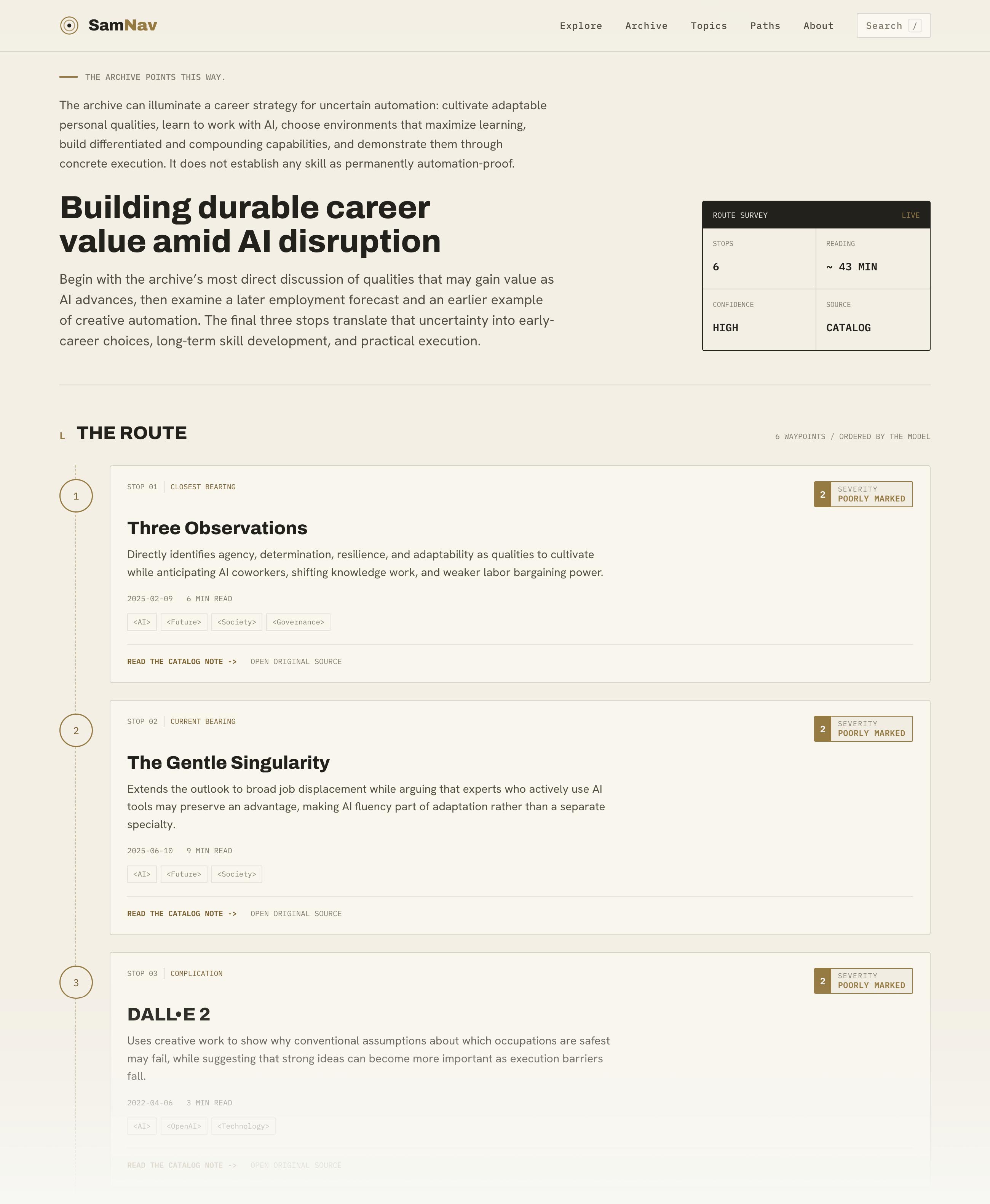
The resulting six-stop route begins with the archive’s most direct recent bearing, moves through AI’s effects on knowledge and creative work, and ends with practical frameworks for choosing compounding skills and important problems. Every waypoint remains attached to an existing catalog record and its original source.
Reader question
I’m early in my career, and I’m worried AI will make a lot of today’s jobs obsolete. What skills are still worth pursuing?
Building durable career skills in an AI-disrupted economySix grounded waypoints move from the closest bearing through complications and practical frameworks, with every stop attached to an existing catalog record.
Honest failure
No clear route is an answer.
Adding an AI window would have made the site larger and the idea smaller.
The model is useful only inside explicit source, runtime, and failure boundaries. If it invents a destination, the route is rejected. If the archive cannot support the question, SamNav says so.
Source boundary
Full article bodies remain outside the public build and live route prompt
Model boundary
The planner may return post IDs, roles, and notes—not authoritative metadata
Failure boundary
Invented destinations are rejected; unsupported questions return no clear route
Runtime boundary
Moderation, rate limits, timeouts, Turnstile, and fail-closed shared safeguards