01
Discover
Theme presets scan filings, ETF holdings, selected institutional reports, news feeds, and curated sources for research leads rather than instant picks.
- Theme-based scans
- Source adapters
- Candidate triage
- No ticker shouting
The contradiction engine
Signal Desk began with a useful admission: I did not know enough about investing to trust either my instincts or a confident machine. Instead of building a trading bot, I built a private research desk that makes a hunch pass through sources, an explicit thesis, counterevidence, uncertainty, and time.
The system resolves companies to SEC identities, stores filings and source-linked research, organizes watchlists through thematic lenses, and produces recommendation categories that preserve evidence, risks, confidence, and what still needs human verification. Ghost trades provide a paper-only record of decisions without connecting the product to a brokerage or order flow.
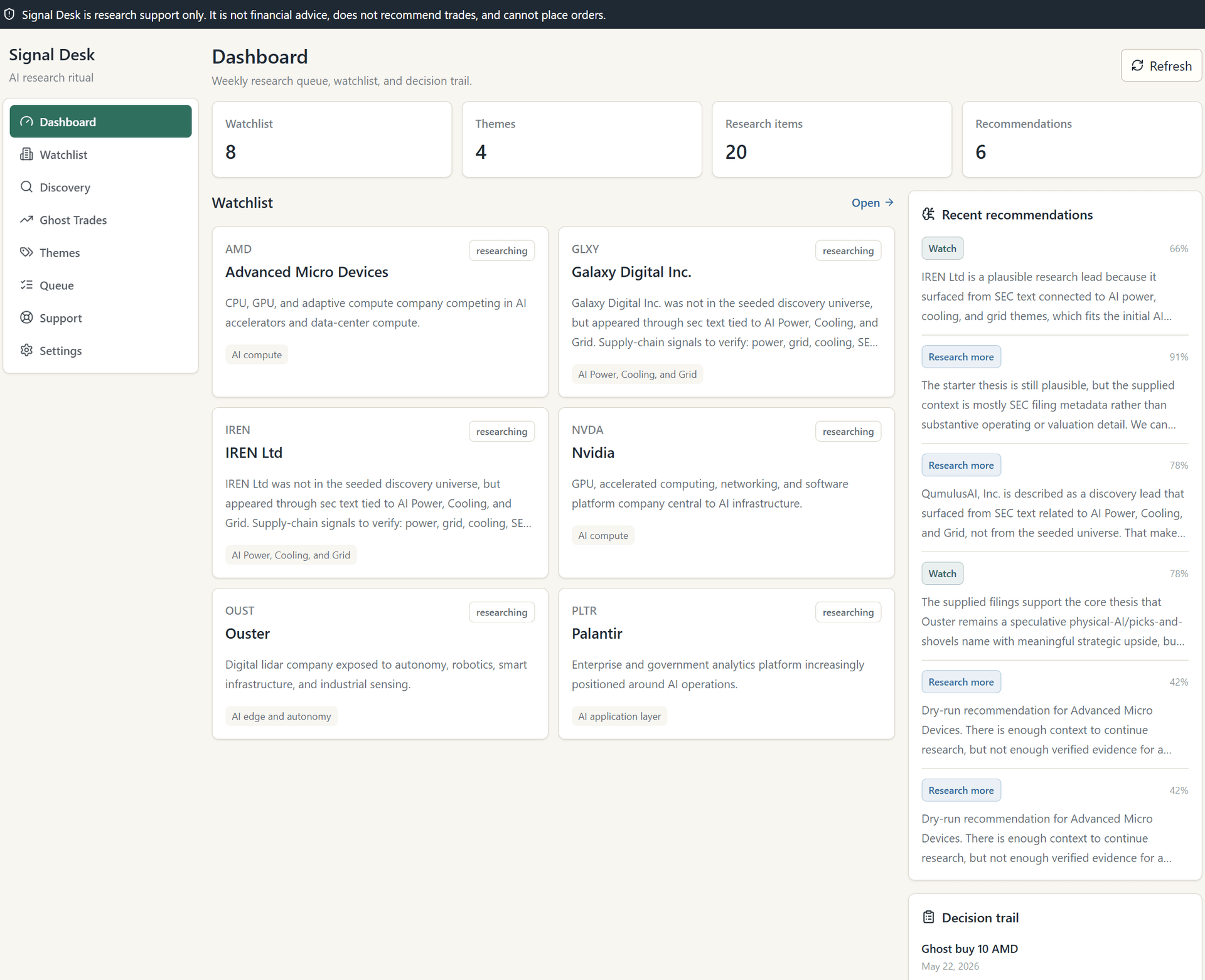
Theme presets scan filings, ETF holdings, selected institutional reports, news feeds, and curated sources for research leads rather than instant picks.
A company file turns curiosity into an inspectable thesis with assumptions, invalidation conditions, metrics, and a declared stance.
Filings, briefs, and summaries feed a skeptical recommendation that keeps evidence, counterevidence, risks, confidence, and open questions visible.
Ghost trades preserve a paper-only decision record with delayed prices and valuation snapshots so a thesis can be revisited after the feeling passes.
Decision trail
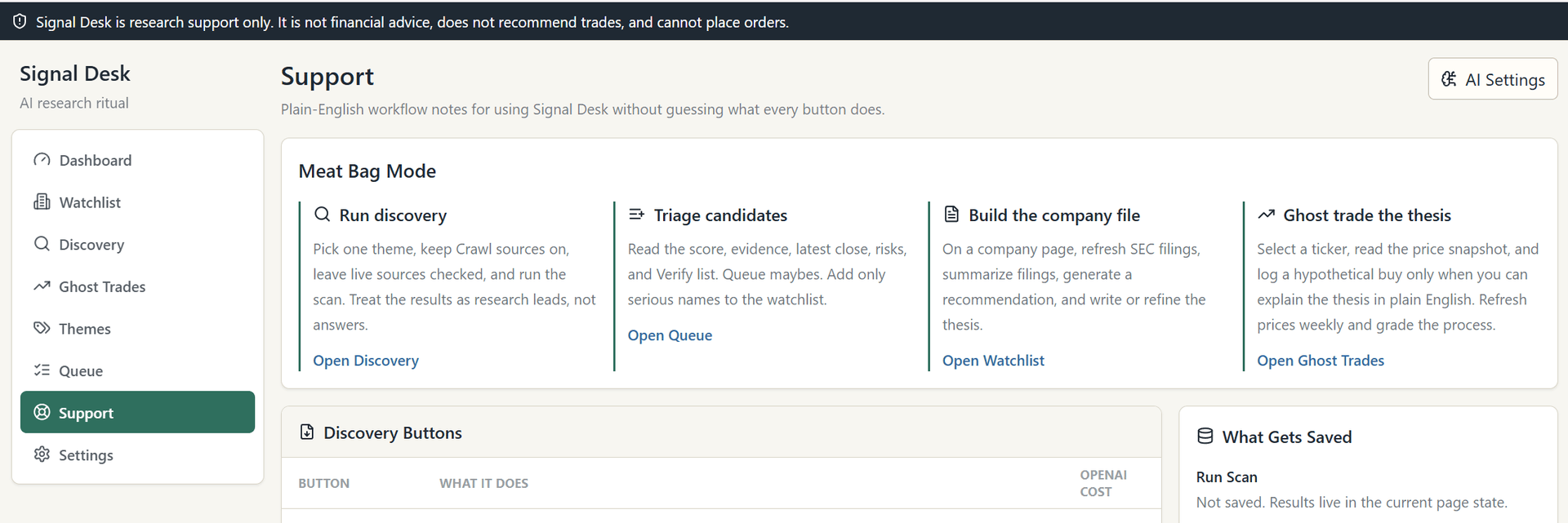
Meat Bag Mode
Signal Desk can summarize a filing or assemble a research brief, but the output is never the end of the workflow. The support view turns each button into a legible human task: run discovery, triage the lead, build the company file, then record a hypothetical decision.
The model’s job is to organize evidence and expose disagreement. The human job is to inspect the source, decide what matters, and remain responsible for the conclusion.
Research support only
The desk can help assemble a case, preserve the bear argument, and remember a paper decision. It cannot place a trade or relieve the researcher of judgment. Each boundary keeps the application pointed at learning rather than execution.