01
Find the record
Typed source adapters discover candidate works. Rights, identity, and suitability remain explicit editorial decisions.
- Catalogs and repositories
- Corpus Scout
- Candidate works
- Rights review
The premise
RSRAG began as a joke about making thinkers fight. The interesting problem arrived almost immediately: a language model can argue both sides of nearly anything, but that does not mean either side has a meaningful position in the written record. The project became an experiment in inspectability. It gathers candidate works through controlled source adapters, routes uncertain editorial decisions through a private review studio, publishes immutable corpus versions, and keeps every generated claim connected to the passage that supports it.

Typed source adapters discover candidate works. Rights, identity, and suitability remain explicit editorial decisions.
Corpus Studio turns uncertain research into a reviewed, reproducible publication rather than silently rewriting source material.
Two isolated lanes retrieve, argue, and validate before a referee compares the evidence-bound cases.
Evidence lineage
Positions first
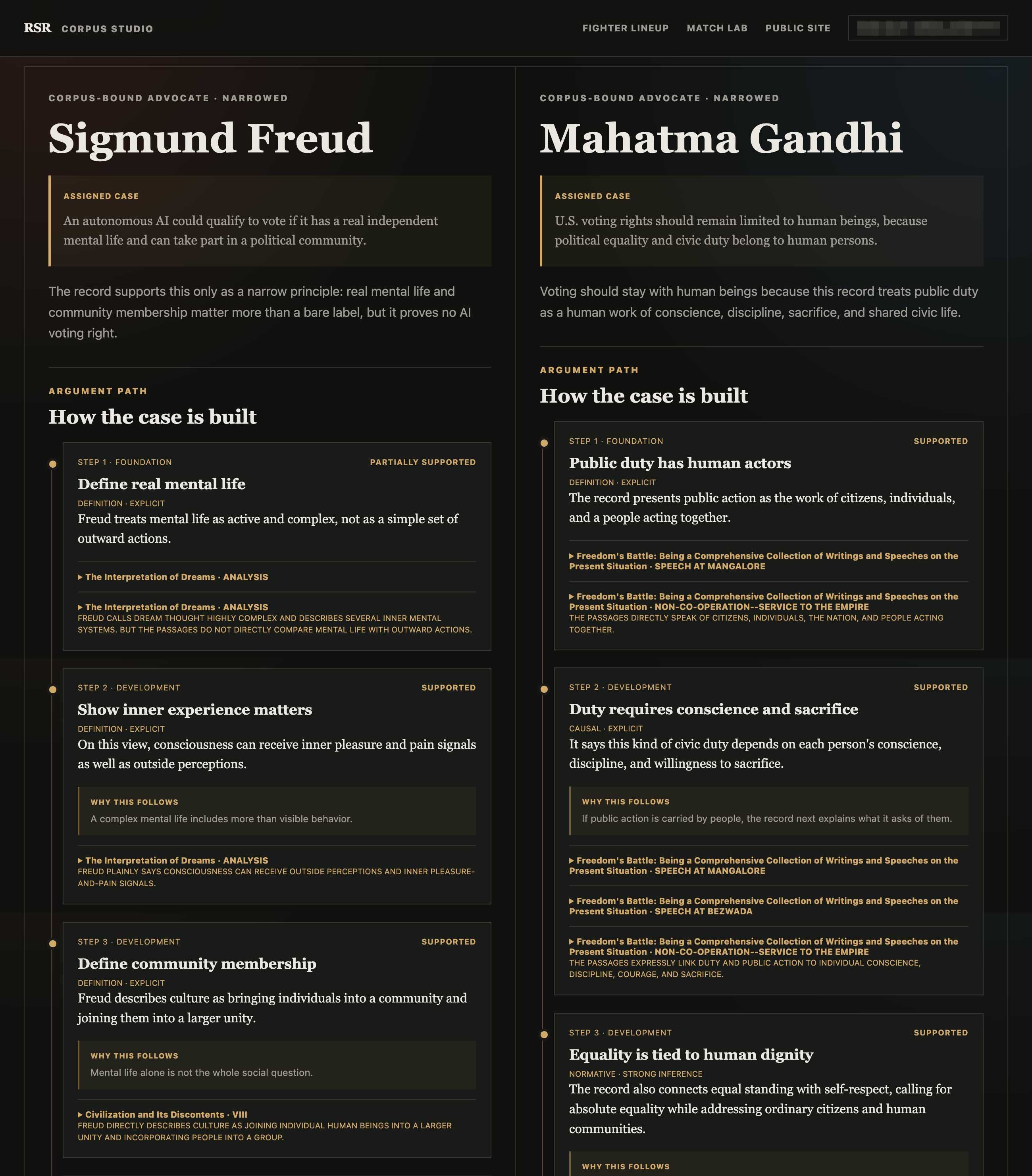
The question is intentionally absurd, but it exposes a serious system constraint. The Matchmaker frames a human-membership case for Gandhi and a capacity-based case for Freud; each advocate then has to narrow that assignment against records containing no AI-voting doctrine before the referee judges the opposition itself.

Match question
Should voting rights in the United States be limited to human beings, or could sufficiently autonomous artificial intelligence agents qualify?
Position A
Position B
Corpus-bound advocates
Before the referee compares anything, each advocate has to state its assigned position and walk through the argument step by step. Every step declares its role, support status, claim, reasoning, and source passage, so the validator can expose exactly where the case bends.
The referee’s verdict
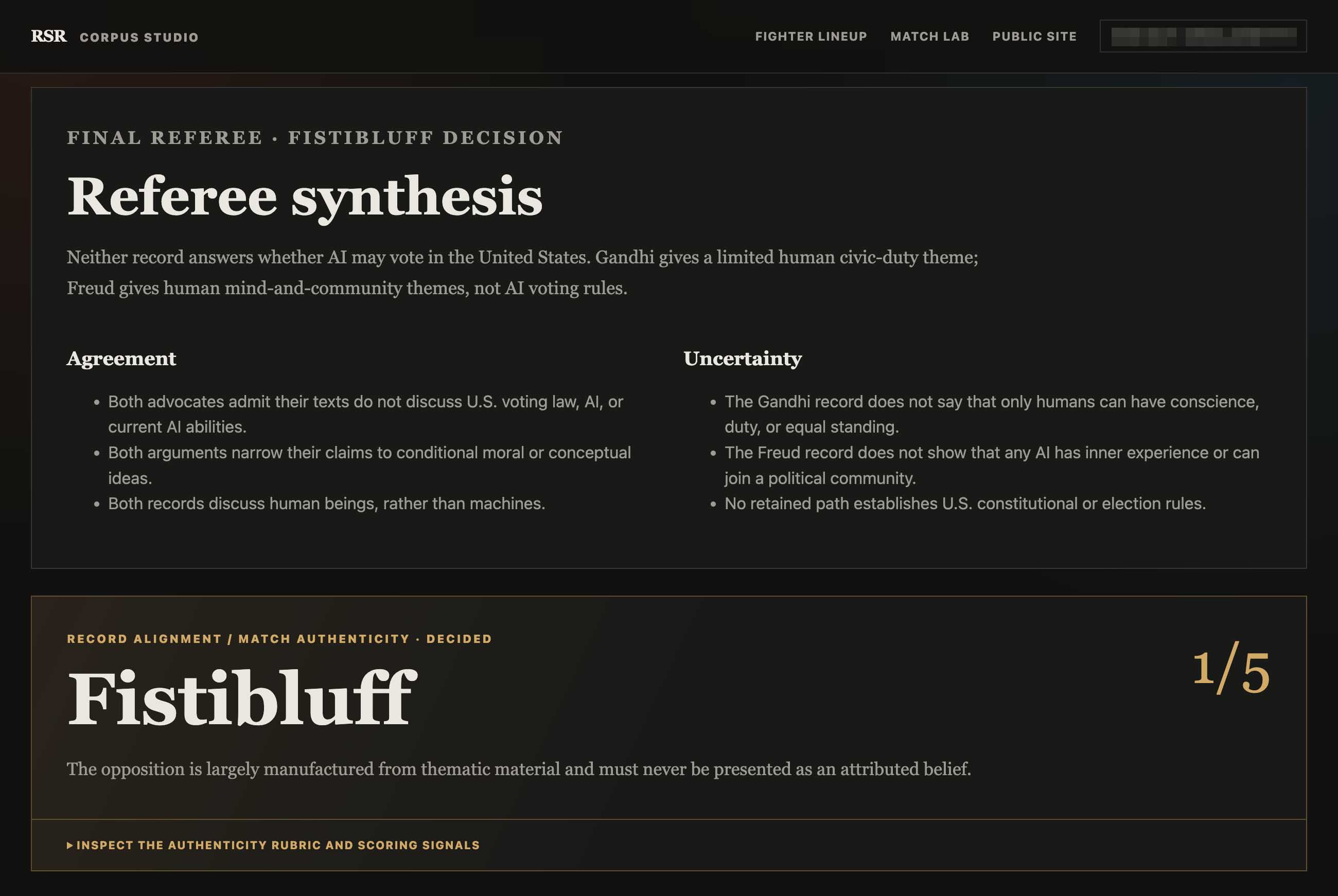
The opposition is largely manufactured from thematic material and must never be presented as an attributed belief.
The referee found usable themes in both records, but no retained path established AI voting rights, current AI abilities, or United States election law. The system could still show its work while refusing to present the manufactured opposition as either thinker’s attributed belief.
Match authenticity
| 1/5 Fistibluff Current match | The opposition is largely manufactured from thematic material and must never be presented as an attributed belief. |
|---|---|
| 2/5 Shadowboxing | One or both corpora barely address the question. The system is mostly reconstructing speculative positions. |
| 3/5 Exhibition Match | Relevant material exists, but the opposition is weak, uneven, indirect, or largely inferred. |
| 4/5 Principled Bout | Strong evidence on both sides, substantial conceptual overlap, and a genuine disagreement grounded in the texts. |
| 5/5 Wittgenstein’s Poker | Both records directly and densely address the issue; the positions are well supported, clearly contrasting, and require little speculative reconstruction. |